Research Papers, Cyber Summer Camp, Local Business Hacking, or: Eric's Summer 2026 Update
My blog hasn’t been updated in a while (oh… three years???) and I wanted to take a moment and update you all on what I’ve been up to this Summer of 2026.
My First Research Papers
Two years into my PhD, I have completed my pre-candidacy and submitted my first research paper as primary author. Coincidentally, on the same day, my first research paper as co-author was accepted! Since both papers have yet to be officially published, I will hold off on sharing details. My first paper as co-author is related to robotics, cybersecurity, and machine learning. My first paper as primary author is related to critical infrastructure, cybersecurity, and economics.
I am very grateful to my professors and peers at my university for collaborating with me on these papers. Though I certainly feel experienced in my cyber and engineering skills, these experiences have taught me that research and academic writing are entire skill set of their own. It is not enough to practice your skills alone, I have learned that to successfully produce a research paper you need to learn how to digest others’ research papers, organize yourself, communicate your findings, and discipline yourself to sit down and do work that can, in the moment, feel tedious or fruitless. It takes practice and experience, just like any other skill you want to learn. This is when it becomes to important to ask for help from others so you can absorb the experience they’ve gained by going through similar challenges.
All in all, the process of seeking a question yet to be answered and calling upon the research of other academics’ is a process that has taught me the value and importance of academia and the scientific method. Every paper, grand or minuscule, is a contribution to humanity’s collective understanding of what is possible and how the world works. Though the process can feel arduous, it is necessary to ensure that our work is reproducible and accelerates our understanding of what we can achieve. Reading papers is absorbing our collective understanding, performing research is expanding that understanding, and writing papers is providing shoulders for others to stand on.
Making Activities and Shirts for Cyber Summer Camp
Oklahoma Cyber Innovation Institute (OCII) hosted their second annual Cyber Summer Camp for high schoolers this year. Last year I got to lead TryHackMe workshops and create Cybersecurity activities for students with Micro:Bit handheld computers. This year, I had the opportunity to create an Operational Technology (OT) Security activity, a Radio-Frequency (RF) Engineering activity, as well as design and order T-Shirts for everyone!
OT Security Activity
Using training workstations equipped with Micro850 Programmable Logic Controllers (PLCs) and various electronic components modules, my co-workers and I made an activity in which students got to connect wires for a PLC, see PLCs be programmed with Ladder Logic, and manipulate the PLC over the MODBUS protocol using a Python script and the pymodbus library.
For this activity, we placed the students in the role of OT Technicians who were called in because first-responders were having trouble changing traffic lights in emergencies. With PLC workstations configured to behave like traffic light systems, students learned how critical infrastructure often depends upon PLCs to dictate how signals are sent and received between important machinery. Whether its the lights at an intersection, public water cleaning systems, power plants, oil refineries, or manufacturing, the difference between you having a good day and a bad day is PLCs being kept up and running as intended. Students learned first-hand how even one improperly connected wire could prevent power from being sent to the rest of the system. With ladder logic, they saw how OT Technicians use visual rung diagrams to configure the operation of sensors and machinery. In writing python MODBUS scripts, the students witnessed how the traffic lights could be arbitrarily controlled by a few lines of code. With this experience, students have a deeper understanding of how, without proper security, nothing is stopping malicious actors from seizing control of critical infrastructure and inflicting harm onto those who depend on it.
RF Engineering Activity
With aluminum foil and Micro:Bits’ Bluetooth communication, we taught students about how radio waves are tangible and can be interacted with using something you might find in your kitchen! I wanted the kids to step away from the keyboards and touch grass while still learning something exciting about how the signals that are present in their everyday lives. After a lesson on the electromagnetic spectrum and radio waves, the students partner up and program their Micro:Bits to broadcast secret numbers over Bluetooth Low Energy (BLE). When their partners’ Micro:Bits receive their shared secret number, the devices play a custom melody they set. After a programming session filled with the chaotic harmony of 30 different chiptunes in the classroom, we explain the rest of the activity and head outside giving each student a whiteboard and a square foot of aluminum foil.
Outside in a big, open field, students conduct a series of experiments to find the maximum distances their Micro:Bits can communicate when the sending and receiving Micro:Bits are in different configurations: without the foil sheet, with the foil sheet behind the Micro:Bit, and with the foil sheet wrapped around the Micro:Bit. After conducting experiments and documenting their observations, the students start noticing differences in how the aluminum foil configurations affect the distance that the signal can be sent and received.
What made me especially happy was seeing the students create experiments and hypotheses of their own. For example, some tried seeing how different shapes of foil affected the signal, and some found that standing next to a metal pole appeared to increase the broadcast distance.
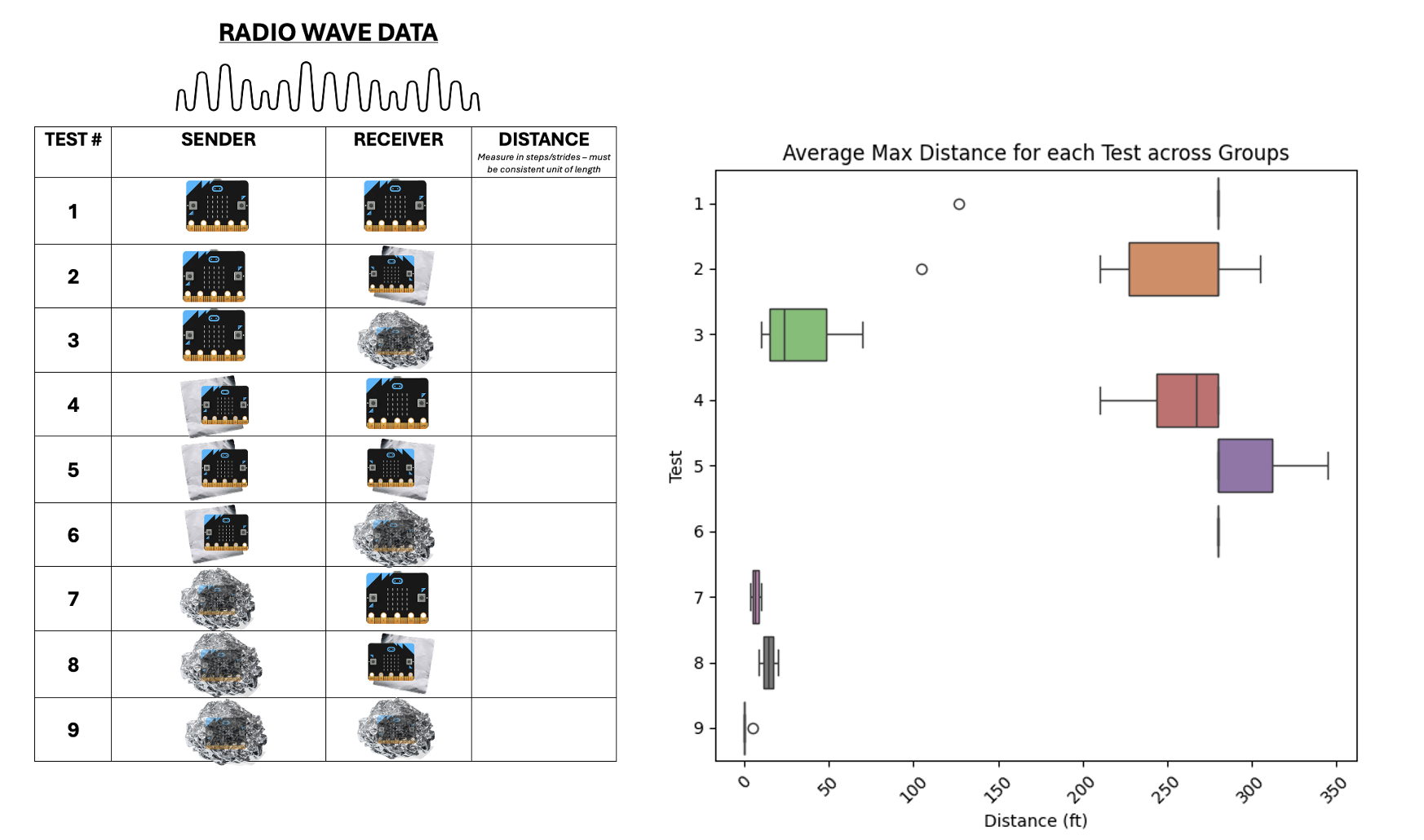
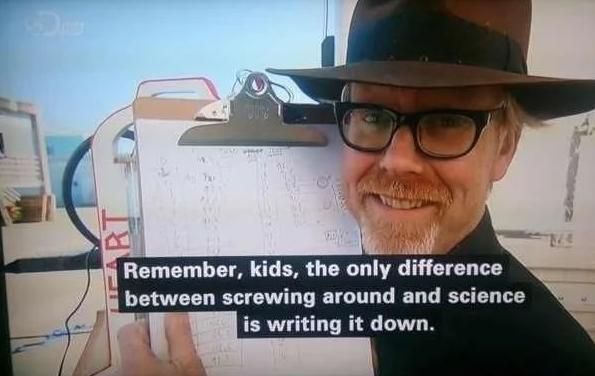
After the activity was over, I collected everyone’s observations and used a Jupyter Notebook to create a box plot as a visualization their research! The students got to experience first hand how radio frequencies can be engineered and how, just like Adam Savage said, “the only difference between screwing around and science is writing it down.”
On a side note, aluminum foil RF hacking really can be useful! Back in my first year of college, I could hardly get any Wi-Fi signal in my dorm. Inspired by Elliot Alderson in Season 2, Episode 9 of Mr. Robot, I took an empty Pringles can (obtained for scientific reasons), cut a hole in the cardboard siding and inserted the remains of a USB Wi-Fi adapter to have the bottom aluminum plate act as a mini-satellite dish for Wi-Fi signals. When I stuck the cantenna out of my dorm’s window, I was able to drastically improve the Wi-Fi signal connection and enjoyed the Internet while my dorm neighbors groaned from having to use Ethernet.
You get a T-shirt, and you get a T-shirt!
I don’t just do STEM nerd things, I also do art nerd things! I had the opportunity to design and order t-shirts again for this year’s Cyber Summer Camp. I start off by pitching design ideas on pen and paper to my coworkers. Once there’s an idea with strong approval, I make mock-up variations of the idea in vector-drawing programs Inkscape and Adobe Illustrator. After multiple rounds of feedback and revisions, I have a vector file designed to use the least amount of colors while still looking great. By making the vector file ourselves, we can work with a local printmaker and we won’t strain their designers as much since the design is almost production ready and just needs to be tweaked for their particular printing arrangements. This saves us money by reducing the amount of hours the printmaker designers need to produce the final design, and by limiting the amount of colors we reduce the amount of inks needed to create the print. Finally, I request quotes from local printmakers using our design, discuss the details with them, and find the best printmaker to produce our design. All together, we save money and get a quicker turn around on shirts while making the printmakers’ lives easier.
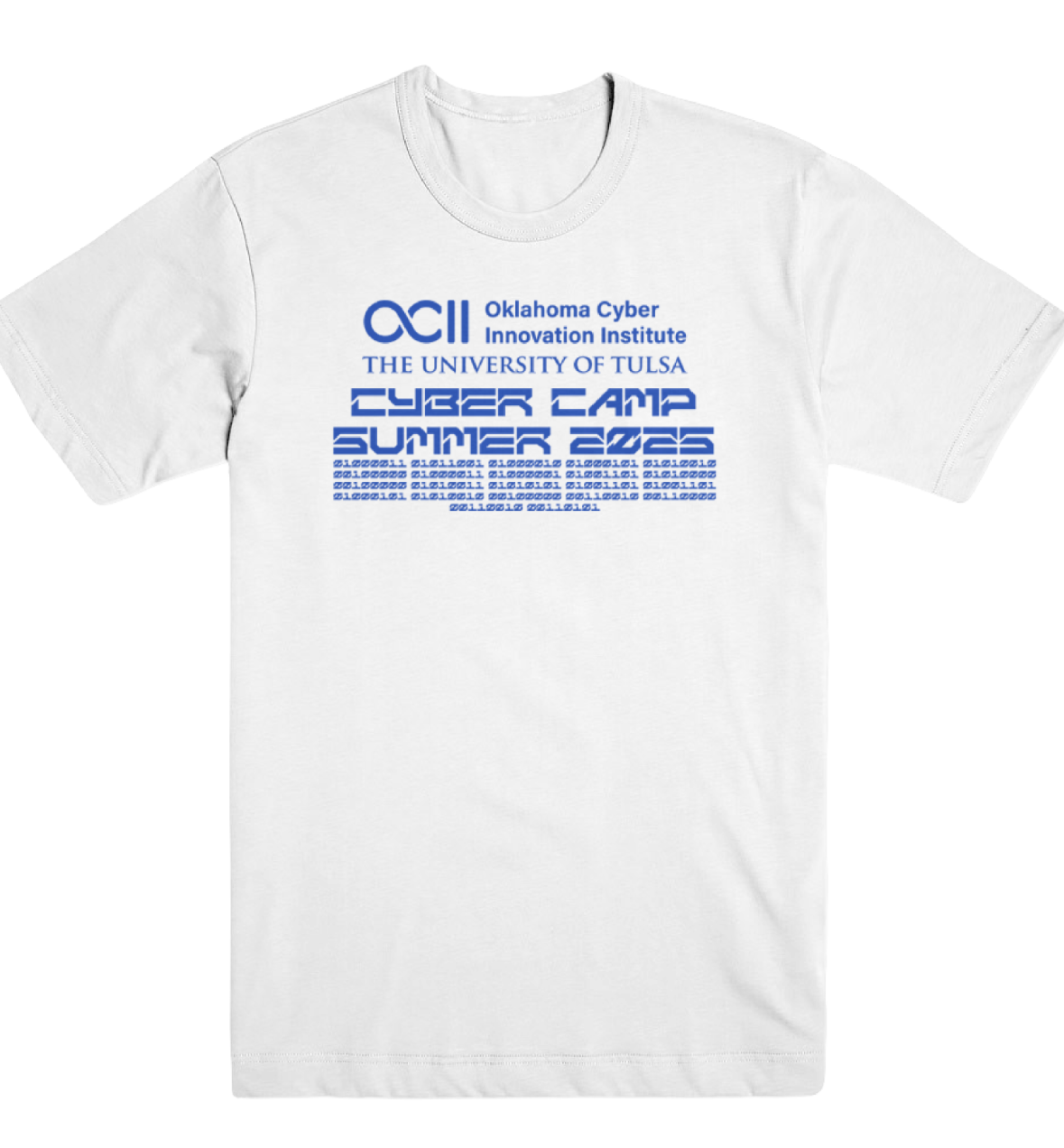
Last year’s camp shirt was a simple, single-color text-based design that used cyberpunk aesthetics and binary text to create a clean, fun, and engaging T-shirt that captures our camp’s sense in fun with cybersecurity activities.
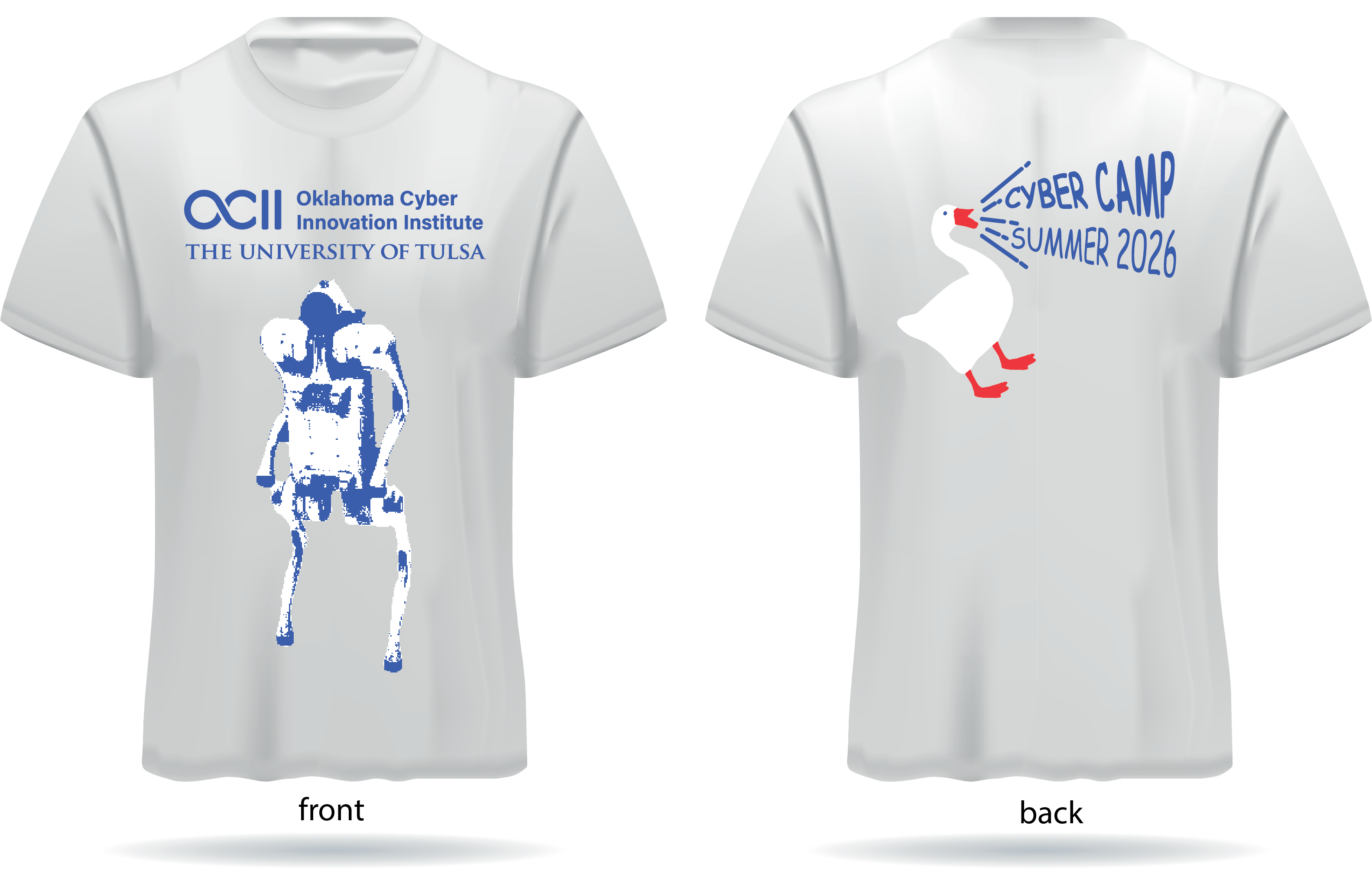
This year’s camp shirt was a three-color design that featured OCII’s logo and a dithered, standing Unitree Go2 robot dog from last year’s photos on the front. On the back is a mischievous (and some might say entitled) cyber goose shouting “Cyber Summer Camp 2026”. The front’s dithered robot dog provides an interesting, cyber-themed visual of a robot we feature in our work while showcasing our logo to identify ourselves on the shirt. The back’s goose design captures the lighthearted, chaotic nature of cybersecurity and curiosity that drives our field. Simultaneously, the silly goose helps contrast from the typical grimy, cyberpunk imagery that tends to be associated with cybersecurity. Cybersecurity is for everyone, and you can enjoy cybersecurity even if you don’t see yourself in the edgy, black-hoodie hacker imagery. With an odd-looking robot dog and a fun-looking goose, our 2026 shirt captures the curiosity and intrigue of those familiar and unfamiliar with cybersecurity.
Tulsa Tech Week
Tech Tai of Tulsa Tech Week and OKC Tech Week visited our Cyber Summer Camp and interviewed us! It was great to meet her, she’s a very awesome person with lots of experience and wisdom who’s doing great things by broadcasting the tech communities and opportunities in Tulsa and Oklahoma City. Check our her and her team’s websites for links to their social media!
Hacking a Local Business
If they give me permission to share a redacted copy of the report I gave them, I would like to upload it here. Out of respect for their privacy, all I will say is I received permission to perform a pro bono security audit of a local business’s Wi-Fi network. I wrote them a report on findings and recommendations, then had the opportunity to help them apply my recommendations.
What’s Next
This has been an amazing journey so far. I will continue being a PhD student working on OT Security Education at OCII, wrap up my courses, and progress my pre-candidacy paper into my thesis. I’m looking forward to sharing what happens next with you all!